Midwest Pawnbrokers Convention 2026: A Recap — and a Conversation We Need to Have
Midwest Pawnbrokers Convention 2026: A Recap — and a Conversation We Need to Have
First, to our sponsors and exhibitors: thank you. Thirty-nine companies filled every booth. Vendors came from New York, Los Angeles, Tel Aviv, and everywhere in between. They brought their best products, their best people, and their genuine belief that this event is worth investing in. We do not take that lightly.
SURVEY: Please provide feedback HERE.
The sessions delivered enormous value: Jeff Wilhelm opened Saturday morning with a session on managing stress and conflict in the workplace that honestly felt like something everyone in the building needed. Attorney Bradley Pendergast and Kelly Swisher walked through the laws affecting pawn. Mike Doyle tackled AI in the pawnshop. Yigal Adato delivered an engaging talk on leadership and value. Joey Leza and Steve Stallcup led afternoon breakout sessions that addressed some of the biggest challenges of business ownership, while Aleah Arrundale and Cyndee Harrison offered buckets of actionable sales and marketing advice. The evening dinner was kicked off by a tribute toast from our beloved Greg Engram, followed by a good meal, the auction, a DJ, and karaoke. Meanwhile, the Sunday morning Wisdom Forum, something we tried for the first time, was well attended and well received.
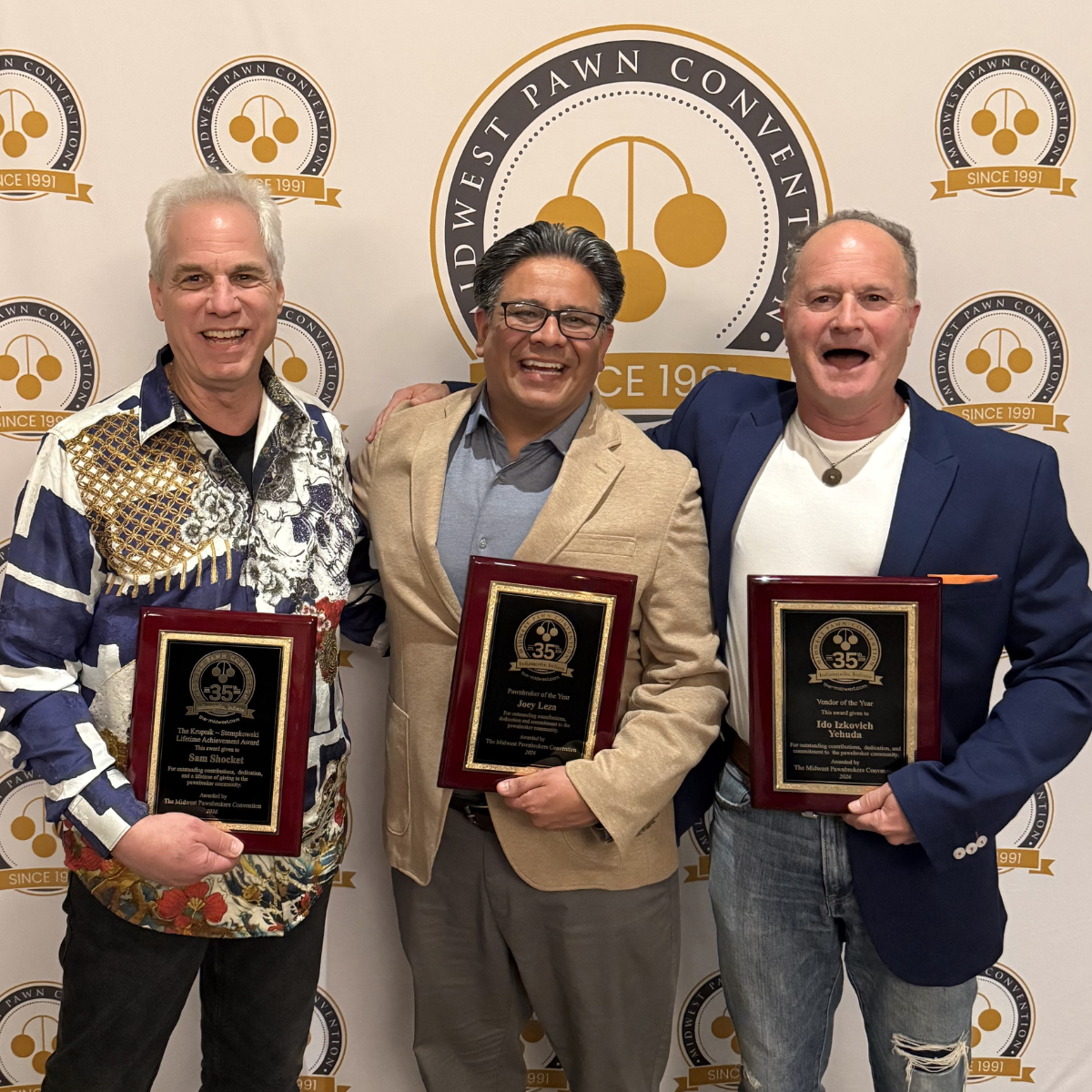
This year's awards thanked some people who continually show up, and it was a pleasure to shine a light on their contributions: Pawnbroker of the Year: Joey Leza. Industry Partner of the Year: Yehuda. And the Krupnik Stempkowski Lifetime Achievement Award: Sam Shocket.
All in all, everything came together the way it should. We're grateful. And we're proud of this show. But we'd be doing the industry a disservice if we stopped there.
It's Time to Have a Real Conversation About Tradeshows
Here is something that no one else seems to be saying out loud: The independent pawnbroker is a shrinking constituency, and it's time to right-size.
According to IBISWorld, the number of independent pawn enterprises in the United States (the actual ownership—individuals or groups writing the checks, rather than the physical storefronts) has declined at a rate of 1.3% per year for five consecutive years, dropping to approximately 3,855 decision-makers as of 2025. The reason isn't hard to find.
FirstCash now operates more than 3,300 pawn locations across three continents. In January 2026, EZCORP acquired a controlling interest in Founders One, adding 105 more stores. The two largest publicly traded pawnbrokers, together, hold roughly a quarter of the North American market, and they are growing by acquiring the independent shops that have historically been the backbone of all the associations and shows.
The industry's revenue is growing. The number of independent operators is not. That distinction matters enormously when you are trying to fill a convention.
At the same time, the exhibitors and vendors who support these events are exhausted. Funny enough, they really didn't complain to us about the costs or about criss-crossing the country to attend the growing number of shows. These men and women show up for tradeshow after tradeshow, competing for the same shrinking pool of attendees and paying booth fees that keep rising while the audiences don't. But there will come a point where they will be tapped out, and the smaller ones will be squeezed out first.
We are standing at the edge of a moment when the regional shows compete against one another and against the national Expo. Doing so will serve no one well.
We are close to a point where budgets get divided and the quality of every experience drops. As an industry, we need to stop treating vendors as a revenue source and start treating them as true partners. That means finding a common-sense approach to right-sizing our calendar before the market forces us to.
Pawn is one industry with many voices. Some are in the same groups or associations as you. Some are not. But there is no longer any 'us' or 'them'.
Consider This
As the industry shrinks, state and regional shows and associations become more critical than ever. Events like this one serve specific communities in specific ways because let's be clear, the single most important thing any pawnbroker can do for the future of their business happens in the rooms where the rules get written by people who may have never stepped inside a pawn shop. That is where the industry's future is actually being decided: the city halls, statehouses, and congressional offices.
Granted, legislative advocacy can feel distant and abstract (until it isn't). As Kelly famously noted while leading Illinois through an historic legislative battle, "We have to win every battle we fight. They only have to win one." Since we never know where the next fight will pop up, the state and regional shows become increasingly vital.
Tradeshows are tangible, relevant, timely, and enjoyable. What feels like walking the floor, seeing new products and services, having conversations, and learning ways to grow your business is also the process of building real relationships with the people who will stand alongside you when the moment comes to take action.
And experience has demonstrated that those people come from large and small trade associations, publicly traded companies, industry partners, and fellow independents—all of whom are seen, from the outside, as a single industry. The best version of what a tradeshow can be is a gathering of people who are invested enough in this industry to show up for it.
The problem is what happens when the gathering becomes the point.
Tradeshows and events can look profitable on the surface and generate impressive top-line revenue.
But it is all a massive outlay of resources.
Midwest is the biggest little show in the pawn industry. We run on volunteer manpower. We handle our own AV, and we can choose a city like Indianapolis over a flashier address with a flashier invoice. Just like the other state and regional shows do.
But here is what the industry needs to answer: How many shows are too many? Who benefits when they multiply? Who pays when the quality thins out? At what point does an event exist just to fund itself, and how does that benefit pawn?
We'll be thinking about all this between now and next year and stand ready to participate in that conversation. We hope you will, too, and we invite your feedback on Midwest, specifically.
Thank you for being in Indianapolis. And if you weren't, we appreciate your support from afar. See you in 2027.
